Homework 2
- You are expected to work individually.
- Due: Friday Janurary 23rd at 11pm EST (Baltimore time).
Before trying to make a submission for this homework, make sure you have successfully joined the course Github organization jhu-oose-sp26 (check out the Logistics page on the course website!)
Getting set up!
- Please go to https://classroom.github.com/a/jsfF0iSa
- Login to your GitHub account and accept the invitation!
- A GitHub repository will be created for you that contains the starter code. The repository is "private" and you must not change it to a "public" one. You must not add any collaborators to it. Clone this repository locally. Open the folder in your favorite text editor and start working on it.
The starter repository, containing the code for task5, is also available here if you ever need it.
Task 1: Client-Server Architecture
Name at least two benefits and one potential drawback of Client-Server Architecture.
Write the answer in task1.md file.
Task 2: Technology Stack
Suppose you are tasked with designing a new Property Management application that allows users to:
- Pay monthly rent
- Submit and track maintenance requests
- Exchange messages with their landlord
- View a list of community events
Your assignment consists of two parts:
Part 1: AI-Assisted Design
Ask an AI assistant (e.g., ChatGPT) to complete the following tasks for the proposed application:
- Write a clear problem statement
- Propose several relevant user stories
- Recommend the most suitable type of application (Mobile, Web, or Desktop)
- Propose an appropriate software architecture
- Suggest a suitable software stack
You should record and preserve the AI-generated responses, as they will be used in the next part of the assignment.
Part 2: Critical Reflection and Evaluation
Using your own judgment, critically reflect on and evaluate each of the AI-generated responses from Part 1. For every suggestion provided by the AI, clearly state whether you agree or disagree and explain your reasoning.
In particular, address the following for each item:
- Why you believe the suggestion is reasonable and appropriate, or
- Why you believe the suggestion is not the best choice, and what alternative(s) you would propose instead
Some portions of the AI’s response may go beyond your current technical knowledge or practical experience. That is expected and acceptable. In such cases, you should:
- Focus your critique on the aspects you understand and can reasonably evaluate, and/or
- Adjust or refine your prompt to the AI to request explanations, simplifications, or alternative options that are more aligned with your current level of knowledge
- Your evaluation should demonstrate thoughtful analysis and an understanding of software engineering principles to the extent appropriate for your background.
Include all AI answers along with your own answers (separated clearly) in task2.md file.
Task 3: UML Class Relationships
For each of the UML class diagrams shown below, indicate the name used to describe the relationship (e.g., an inheritance relationship) between the classes and describe what the diagram communicates about the relationship (e.g., interpret the multiplicity and navigability of a relationship).


Write the answer in task3.md file.
Task 4: From Model to Implementation
Consider the UML class diagram shown below:
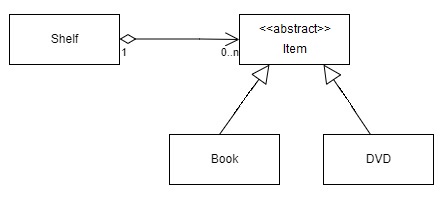
It represents the design which models a personal library system. A person (i.e., user of the system) has one or more shelf where different items such as books and dvds are kept. You must include fields and methods that are necessary to support relationships between the other classes shown on the UML diagram but it is not necessary to include any others. Assume that you can both add and remove items from the shelf. Further, assume that the items must be stored in the shelf in the order in which they were added and that the shelf must not contain duplicate Item objects.
Write simplest implementation for these classes (in Java) in files named Shelf.java, Item.java, Book.java, and DVD.java.
Task 5: From Implementation to Model
Draw a UML class diagram to represent the relationship of all the types (classes) in the starter repository that was cloned for you in the "Getting Setup" step. The Java files are part of the implementation of a system that models a few different types of animals.
Please draw the UML diagram using software such as https://www.drawio.com/ and save it as an image task5.png. Hand-drawn diagrams will not be accepted.
Submission
- Go to Gradescope
- Click on Homework 2.
- You will be presented with the submission prompt.
- Click on "Connect to GitHub".
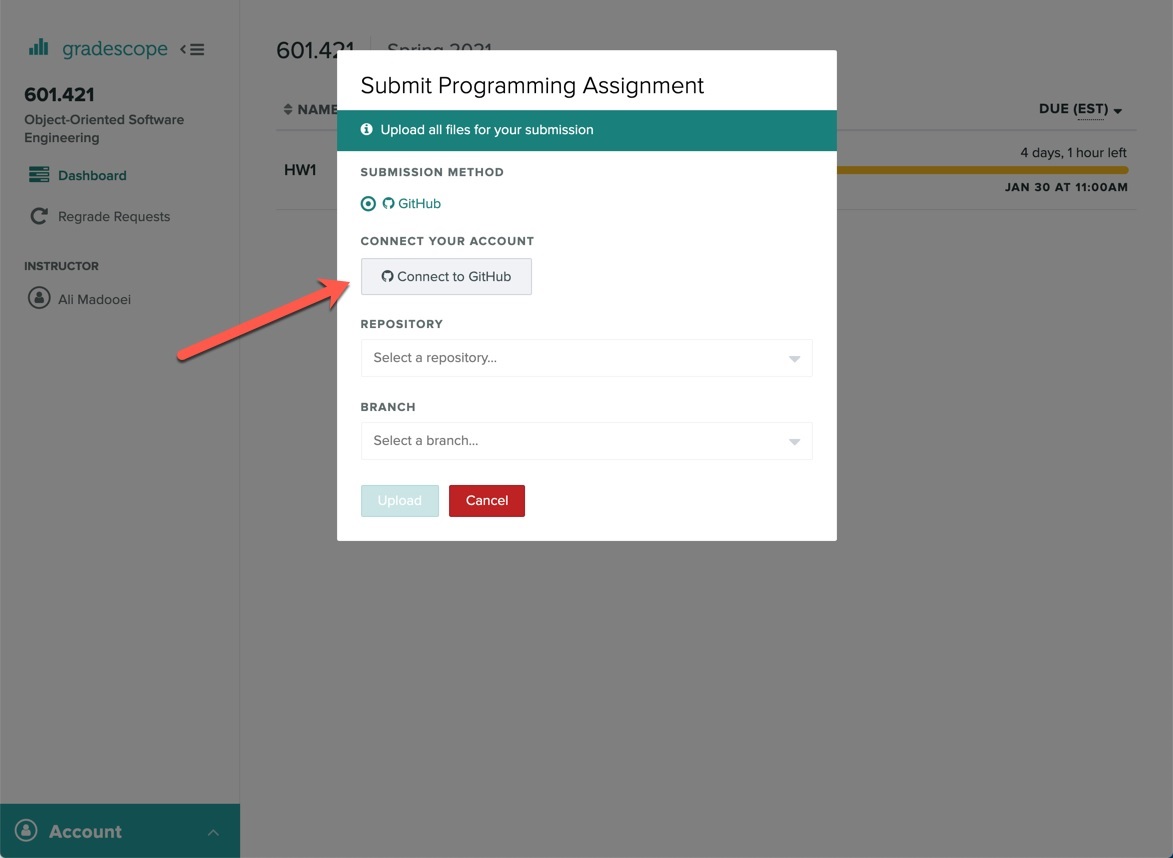
You will be redirected to authorize Gradescope to communicate with the GitHub API and access your repositories! Once Gradescope and GitHub are linked, they stay linked! You don't need to repeat this process.
- Select your homework repository.
- Select the "main" branch.
- Hit Upload!
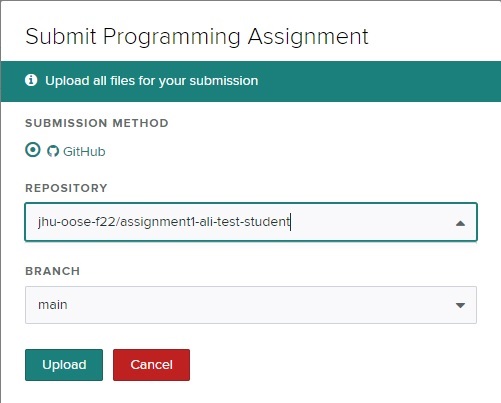
The files in your GitHub repository are now submitted as your homework submission.
If you had already done the above steps to connect Github and Gradescope, then you would not need repeat them again here!
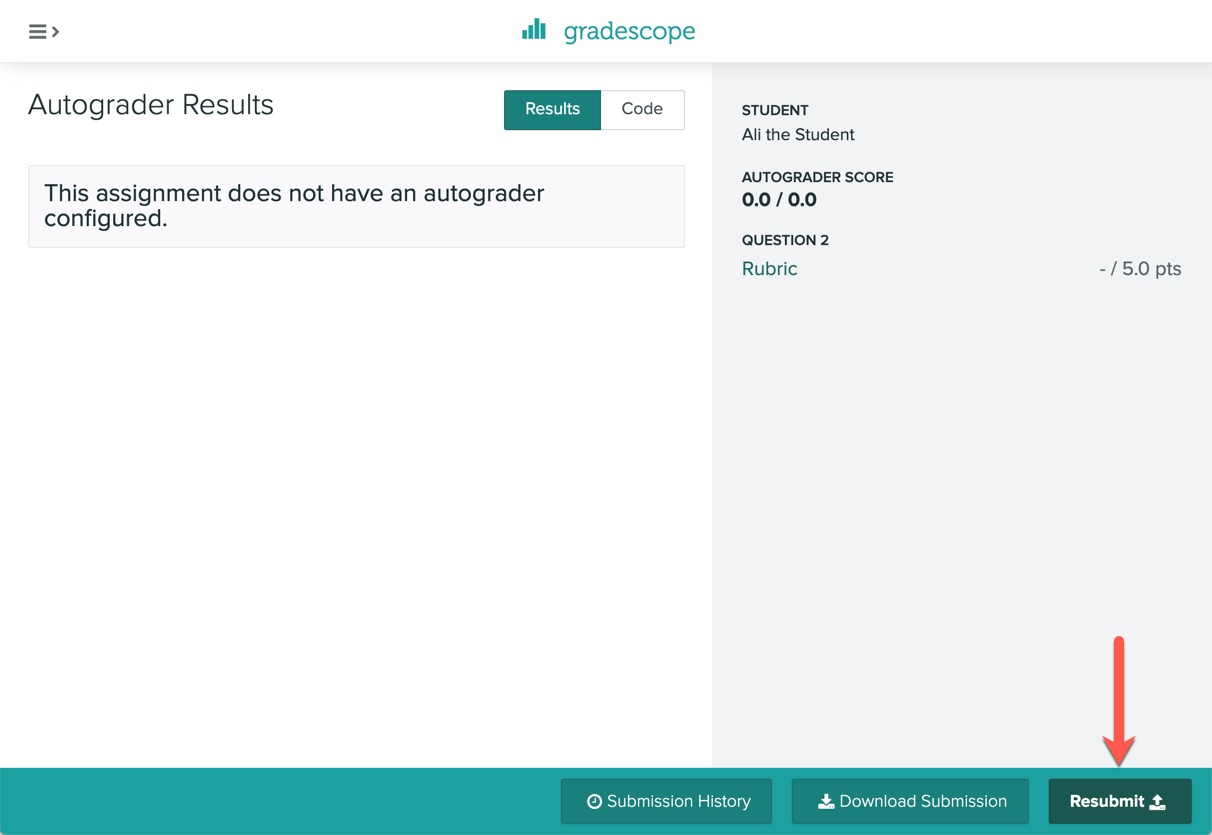
Gradescope does not automatically fetch changes from your GitHub repository. If you make any updates to your repository, you must "resubmit" your work to Gradescope. (The resubmission process is exactly the same as the first submission.)